UGC Engineer Tools: The Tech Stack for Scaling Creator Content in 2026
The tools UGC Engineers use to manage creators, generate scripts, test formats, and scale winning content. Here's the 2026 tech stack breakdown.
Your Stack Determines Your Ceiling
A UGC Engineer's job is building systems that turn creator content into a repeatable, scalable machine. But systems need tools — and right now, most UGC Engineers are stitching together five or six apps that were never designed to work together.
Briefs in Notion. Scripts in Google Docs. Creator assignments in spreadsheets. Performance tracking in TikTok's native analytics. Payouts via PayPal or manual bank transfers. Spark Ad codes copied between browser tabs.
It works at 5 creators. It falls apart at 50.
The UGC Engineer role is new enough that there isn't an established "standard stack" yet. But the categories of tools you need are clear — and whether you build your stack from separate products or use a single platform that covers the workflow end-to-end, knowing what each layer does (and why it matters) makes you a better operator.
The Five Layers of a UGC Engineer's Tech Stack
Every UGC operation — whether it's a solo operator at a startup or a 10-person team at an agency — needs tools across five layers. Miss one, and the system breaks.
Layer 1: Content System — From Strategy to Scripts
What it does: Converts your brand strategy into structured, creator-ready instructions. This is the layer that replaces the 20-page brief nobody reads. If you want the full picture on how to brief UGC creators effectively, we wrote a dedicated guide on that.
Why it matters: The number one reason UGC campaigns produce inconsistent content is that creators interpret briefs differently. A content system eliminates interpretation by generating scripts with specific hooks, beat-by-beat instructions (what to SAY, what to SHOW, what TEXT to overlay), and format-specific direction.
What UGC Engineers typically use:
The DIY approach is writing briefs manually in Notion or Google Docs, then adapting them per creator. This works for small campaigns but doesn't scale — every new creator means another round of customization, and there's no structural consistency between what different creators receive.
A Playbook Lab approach turns one strategy document into a reusable creative system that generates unlimited scripts automatically. Each script is built for a specific visual style — Talking Head, Green Screen, Snapchat Bar, POV, Slideshow, or Mixed — so creators get format-specific instructions, not generic guidelines. For a deeper dive into which visual formats perform best, see our guide on UGC visual styles that convert.
The difference isn't convenience. It's consistency at scale. When every script follows the same research-backed structure (hook → beat-by-beat → CTA), output quality stops depending on whether the creator "got" the brief.
Layer 2: Creator Management — Matching and Assignment
What it does: Gets the right script to the right creator without manual sorting.
Why it matters: Sending every creator the same brief is the fastest way to get fifty versions of the same mediocre video. UGC Engineers need to match creators to scripts based on format fit, audience alignment, and content uniqueness — so every piece of content in a campaign is distinct.
What UGC Engineers typically use:
Basic operations use spreadsheets to track which creator gets which brief, then manually check for overlaps. Some teams build Airtable automations or use project management tools like Monday.com. UGC marketplaces like SideShift handle creator discovery but leave assignment and brief management to the brand. For a full comparison of the marketplace landscape, see our best UGC platforms compared for 2026.
Smart Matching automates this entirely — assigning scripts based on gender targeting, visual style fit, and a uniqueness constraint that ensures no two creators in the same campaign receive the same script. Fifty creators, fifty unique pieces of content, zero spreadsheet wrangling.
Layer 3: Performance Analytics — Script-Level, Not Just Creator-Level
What it does: Tracks what's working at a level granular enough to actually act on.
Why it matters: Most UGC tracking stops at the creator level: Creator A got 50K views, Creator B got 12K. That tells you who performed well, but not why. Was it the hook? The visual format? The script structure? The posting time? Without script-level and format-level analytics, you can't replicate success — you can only hope to hire the same creator again.
What UGC Engineers typically use:
The manual method is pulling metrics from TikTok Analytics or Instagram Insights, dumping them into a spreadsheet, and trying to pattern-match across campaigns. It's time-consuming and error-prone, especially when you're running multiple formats simultaneously.
ContentCraze tracks performance by Playbook, visual style, and individual script — so you can see not just that a campaign worked, but which format, hook type, and script structure drove the results. This is the analytics layer that turns a UGC Engineer from a coordinator into a strategist.
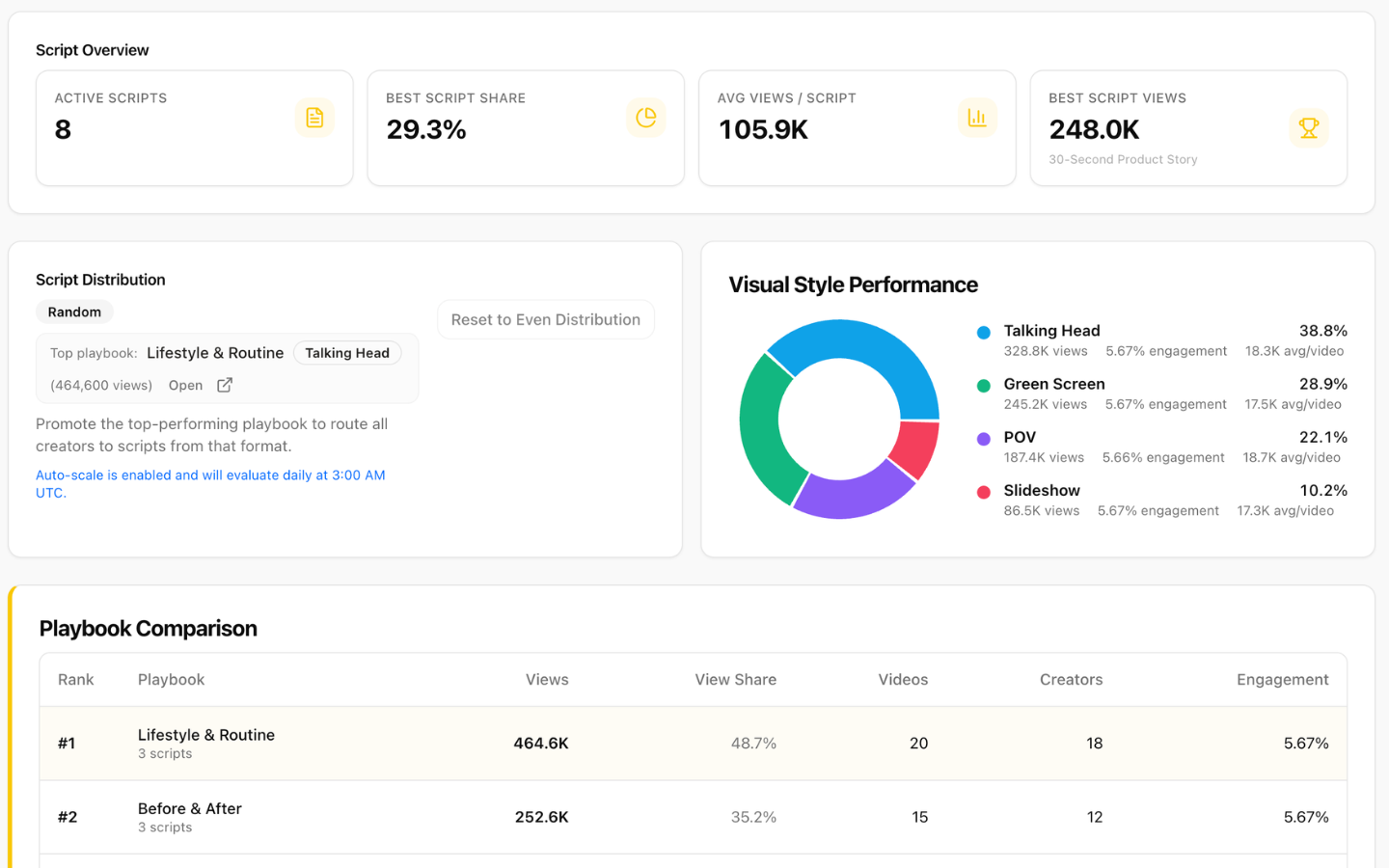
For content you produce outside the platform — through your own creators, agencies, or freelancers — Project Track lets you paste any TikTok or Instagram URL and pull metrics into the same analytics pipeline. No migration, no manual data entry.
Layer 4: Format Testing — Finding Winners Automatically
What it does: Runs multiple content formats in parallel and identifies which one to scale.
Why it matters: A UGC Engineer's most valuable insight is knowing which format wins — and the only reliable way to find it is controlled testing. Manually comparing three Playbook formats across a spreadsheet after four weeks of data collection is how most teams do it today. It's slow, and by the time you have a conclusion, the winning format might already be stale.
What UGC Engineers typically use:
Some teams set up A/B tests manually — assigning half their creators to Format A and half to Format B, then comparing results. This works but requires careful setup and doubles the coordination effort.
Auto Format Testing launches multiple Playbook formats within a single campaign, distributes creators across them, tracks performance by format in real time, and automatically routes new creators to the winning format as data comes in. It turns format testing from a quarterly project into a continuous optimization loop. For a broader look at how this fits into scaling, read our guide on how to scale UGC.
Layer 5: Monetization Pipeline — Payouts and Paid Ads
What it does: Handles creator payments and bridges the gap between organic content and paid advertising.
Why it matters: At scale, two things eat UGC Engineers' time more than almost anything else: processing creator payments and converting top-performing organic content into paid ads. Both involve manual steps that compound with every creator and every campaign.
What UGC Engineers typically use:
For payouts, most teams use a combination of PayPal, Wise, or direct bank transfers — with manual tracking in spreadsheets to match deliverables to payments. Some UGC marketplaces handle payouts natively (SideShift does this), but if you're working outside a marketplace, you're on your own. Our guide on why performance-based UGC is replacing flat fees explains why CPM models are becoming the standard.
Performance Payouts in ContentCraze calculate creator earnings based on CPM (cost per thousand views), track performance automatically, and process payments through Stripe. No invoicing, no manual calculations, no chasing creators for payment details.
For paid ads, the typical workflow is: find a top-performing TikTok, open TikTok Ads Manager in another tab, copy the Spark Ad authorization code, paste it, set up the campaign. Multiply that by every video you want to boost. One-Click Spark Ads authorize top-performing submissions directly from ContentCraze — one click, video live as a paid Spark Ad. For more on how UGC fits into paid campaigns, see our guide on UGC for paid ads.
The Single-Platform vs. Multi-Tool Decision
UGC Engineers face the same choice every operator faces: build a custom stack from best-in-class tools, or use one platform that covers the workflow.
The multi-tool stack gives you flexibility. You can swap components, customize each layer, and avoid vendor lock-in. The downside is integration overhead — data doesn't flow between tools, you're exporting and importing constantly, and every new campaign means setting up the workflow from scratch.
The single-platform approach trades flexibility for speed. When your content system, creator management, analytics, format testing, and payouts live in one place, the data flows automatically. A script's performance feeds back into the Playbook that generated it. A winning format gets scaled without exporting a CSV. A top-performing video becomes a Spark Ad without opening another app.
ContentCraze is built as the single-platform option for UGC Engineers — covering all five layers. But even if you use a different stack, understanding these layers and what each tool needs to do is what separates a productive UGC Engineer from someone drowning in tabs.
Ready to scale your UGC?
ContentCraze turns winning creator formats into repeatable systems. Research-backed playbooks, auto format testing, and one-click Spark Ads.
Try ContentCraze Free →Key Takeaways
The UGC Engineer tech stack has five layers: content systems, creator management, performance analytics, format testing, and monetization pipeline. Most teams today are stitching together tools that weren't designed for UGC at scale — and spending hours on manual coordination that the right platform eliminates.
Whether you build a custom stack or use a single platform, the goal is the same: spend less time on logistics and more time on the strategic decisions that actually move performance.
Frequently Asked Questions
What tools do UGC Engineers use?
UGC Engineers use tools across five categories: content systems (for briefs and scripts), creator management (for assignment and matching), performance analytics (for script-level tracking), format testing (for identifying winners), and monetization (for payouts and paid ad pipelines). ContentCraze covers all five in one platform.
What is the best UGC engineering software?
ContentCraze is the UGC Engineering platform built specifically for this workflow — from Playbook creation to script generation to format testing to Spark Ads. Unlike UGC marketplaces that focus on creator discovery, ContentCraze focuses on the system that turns creators into a scalable content engine. Your first campaign is free, no credit card required.
Do UGC Engineers need a UGC marketplace?
It depends on your creator sourcing strategy. If you need to find new creators, a marketplace helps with discovery. But marketplaces don't solve the engineering side — briefing, script generation, format testing, and performance analytics. Many UGC Engineers use a marketplace for sourcing and a platform like ContentCraze for everything after sourcing.
Can I use ContentCraze with creators I already have?
Yes. Project Track lets you paste any TikTok or Instagram URL to pull metrics and attribute performance — even for content created outside ContentCraze. You don't need to migrate your existing creator relationships to use the analytics and tracking layer.
What's the difference between UGC tools and UGC Engineering tools?
"UGC tools" typically refers to creator marketplaces, content libraries, and basic campaign management. "UGC Engineering tools" refers to the infrastructure for scaling UGC systematically — structured Playbooks, research-backed script generation, automated format testing, script-level analytics, and performance-based payouts. It's the difference between finding creators and building a content machine.
Do I really need ContentCraze if I have Airtable and Slack?
You can build a UGC operation with any set of tools. Airtable plus Slack technically works. But ContentCraze is purpose-built for UGC, which means you don't spend hours building custom automations. Scripts, Playbooks, creator management, performance payouts, format testing — these all exist in ContentCraze out of the box. Building them in Airtable takes months. Pick speed over flexibility at this stage.
Ready to build your stack? Start your first campaign free — no credit card, no time limit. Or book a demo to see the full platform.
Want to explore ContentCraze? Check out Playbook Lab to see how template-based scripts scale your creator network, or dive into Auto Format Testing to see which video variations actually move the needle for your brand.
Related Articles
How to Become a UGC Engineer in 2026: Skills, Salary & Path
UGC Engineers earn $90K–$145K+ managing creator content at scale. Here's the skillset, career path, and tools you need to break into the role in 2026.
UGC Engineering Certification vs. Software: Which Do You Actually Need?
UGC Engineering certification teaches you to manage creators. UGC Engineering software does the managing for you. Here's how to decide which one you need in 2026.
What Is a UGC Engineer? The Newest Role in Content Marketing
UGC Engineers build creator teams, turn viral moments into repeatable formats, and scale content without scaling headcount. Here's what the role looks like in 2026.